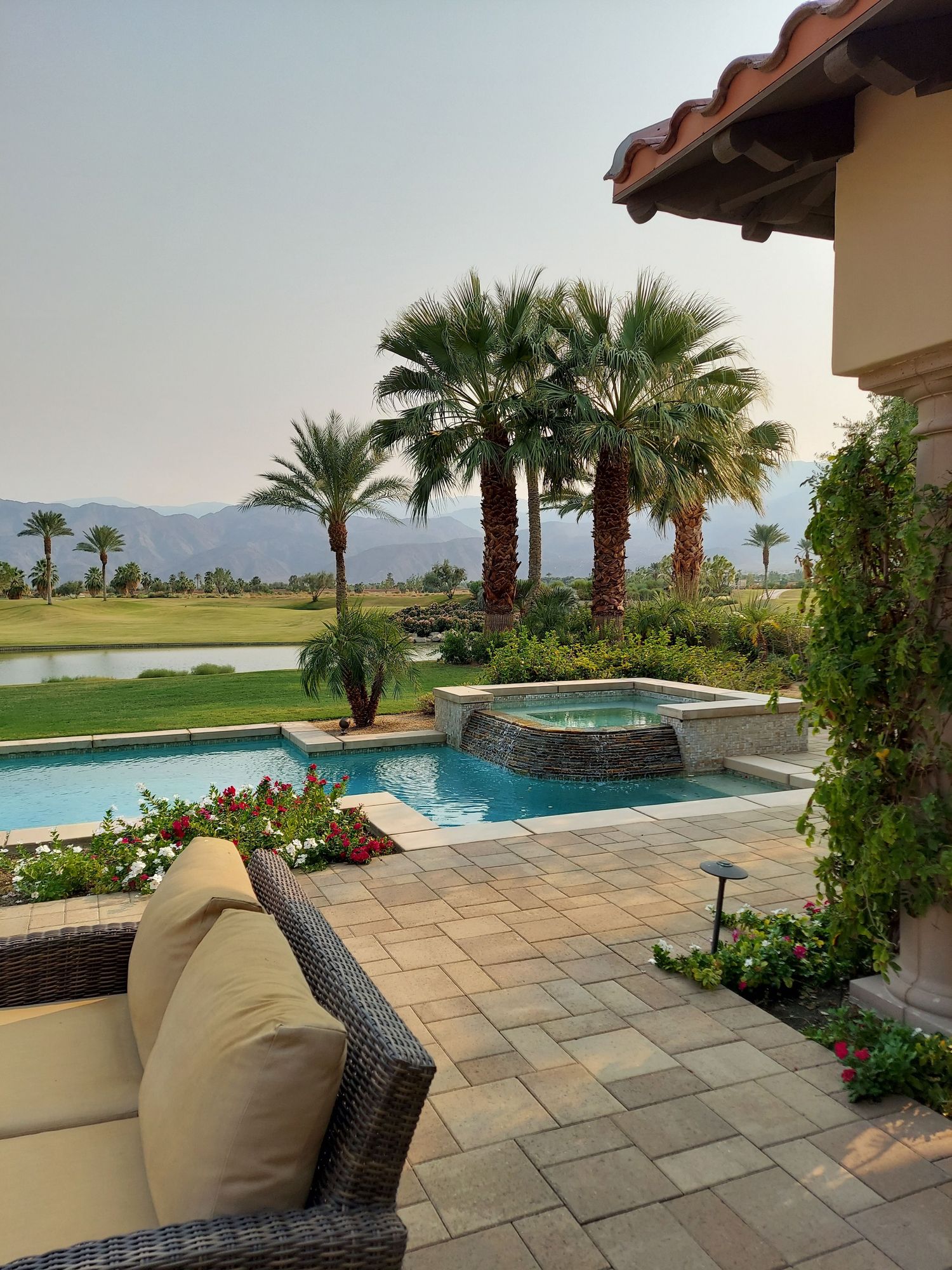
By the middle of July, a bare concrete slab in a Gilbert backyard is too hot to cross barefoot and usually showing its first hairline cracks. How you build a patio here is a heat-and-soil question before it is ever a looks question. Get the desert part right and the good-looking part takes care of itself.
Why pavers suit the desert better than a poured slab
A solid concrete slab and the desert ground do not get along for long. Gilbert’s clay and caliche soils swell and shift with moisture and heat, and a single rigid slab tends to crack when the ground moves under it. Pavers flex with that movement because they are set as individual units, so a little shifting is far less likely to telegraph into a crack across your patio. They are also repairable: lift a few, fix the base, reset them, instead of jackhammering a whole slab. For a climate this hard on surfaces, that flexibility counts for a lot.
Material and color do real work
In this sun, the surface you choose changes whether you can use the patio in summer. Lighter tones reflect heat instead of soaking it up, so a pale travertine or a light concrete paver stays more comfortable than a dark surface that turns into a griddle. Material matters too. Travertine tends to stay cooler underfoot than poured concrete, which is part of why it shows up around so many desert pools. Choosing for heat first, then for how it looks, is how you get a patio you will actually sit on in June.
The base is the whole game
The part that decides whether a paver patio holds up is the part you never see: a properly compacted sub-base, the right depth of road base, and solid edge restraint so the field does not spread over time. This is where cheap installs fall apart. Skip the compaction or the edging and within a couple of seasons you can get sinking, lifting, and gaps. We build the base for the soil it is sitting on, because a beautiful paver set on a bad base is just a slow-motion problem.
Pavers as the backbone of the yard
The best hardscape does not sit in isolation. A patio, a walkway, a seat wall, and a fire feature designed together give the whole yard a structure that planting then softens. That is how we approach a build, hardscape as the bones and plants as the rest, so the finished yard feels like one piece instead of a slab with stuff around it. You can see that approach across our gallery, and it is a big part of why Gilbert homeowners come to us for the patio and end up rethinking the whole space.
Frequently Asked Questions
Do pavers get too hot to walk on?
Some do, but lighter-colored pavers and travertine stay far more comfortable than dark concrete. Material and color choice handle most of the heat question.
Will pavers shift or sink over time?
A properly built and compacted base with solid edge restraint is what keeps them flat. That base work is where it is won or lost.
Pavers or stamped concrete?
Stamped concrete is still one slab, so it cracks the same way poured concrete does. Pavers flex with the ground and repair cleanly, which is why we lean toward them here.
Build a patio that lasts
If your slab is cracking or your yard needs hard surfaces that hold up to the heat, let us look at it together. Start on our contact page.
—